Best Isometric Knee Exercises for Pain Relief & Strength
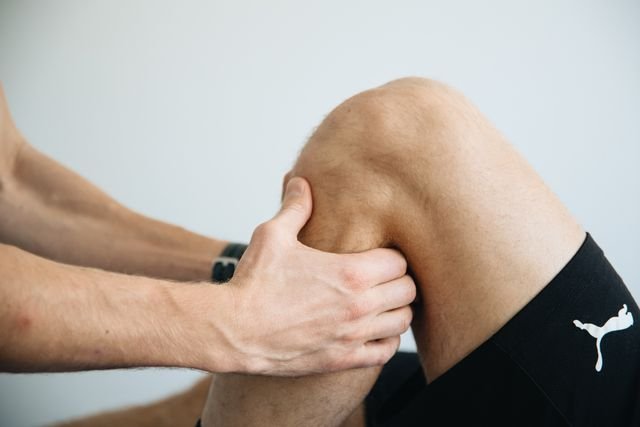
Knee pain does not always mean you have to stop moving altogether. For many people, the challenge is finding a way to keep the muscles working without making things worse. That is where isometric knee exercises come in.
With knee isometrics, the muscle contracts but the joint stays still. There is no bending or straightening under load. This makes them a practical starting point when the knee is painful, swollen, or recovering from surgery.
This article covers the most evidence-supported isometric knee exercises, explains how to do them correctly, and gives you a realistic sense of when they are most useful. If you are post-surgery or managing a diagnosed condition, check with your physiotherapist or surgeon before starting.
What the Research Says
Several published reviews have looked at how well isometric knee exercises work for conditions like osteoarthritis and patellar tendinopathy. The findings are fairly consistent.
A network meta-analysis published in PLOS One (2024) compared isometric, isokinetic, and isotonic resistance training in knee osteoarthritis. All three types produced meaningful improvements in pain and function against conventional physiotherapy alone. Isometric training was a viable option, particularly for patients who could not yet tolerate moving the joint under load.
A separate randomised controlled trial published in PMC (2022) tested isometric quad exercises performed in two different positions. Both groups improved. The researchers observed that the position mattered less than actually doing the work consistently.
What this means practically: isometric leg exercises do not need to be complicated. Done regularly and at the right intensity, they produce real changes in pain levels and muscle function.
Research Insight: Dr Amyn Rajani
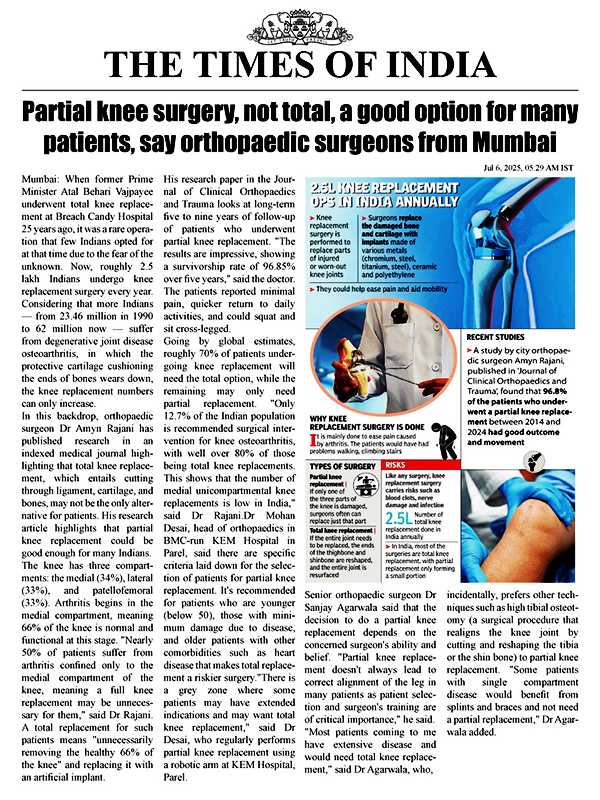
Dr Amyn Rajani is a Consultant Knee, Shoulder & Hip Surgeon at Breach Candy Hospital and Saifee Hospital in Mumbai. He has been working in knee arthroplasty and reconstruction for over two decades. One area of his published research is directly relevant to patients in the early post-operative period, when isometric quad exercises and quadriceps activation form the foundation of recovery.
In a prospective, double-blinded, randomised, placebo-controlled trial published in The Journal of Arthroplasty (2024), Dr Rajani and his team studied whether low-dose duloxetine could help manage pain after bilateral total knee arthroplasty. The trial enrolled 106 patients. The study found that duloxetine provided significantly better pain relief in the first two weeks compared to placebo. By four weeks and three months, the difference between the two groups was no longer significant.
Why does this matter for isometric knee exercises? Because getting pain under control in the early post-operative days is what allows patients to begin quadriceps activation. A patient who can perform a simple quad set on day two is in a better position at week six than one who could not. Research consistently links stronger quadriceps in the early post-surgery weeks with better long-term functional outcomes.
Dr Rajani has also published a case report on quadriceps rupture following total knee arthroplasty, available through PMC (2022). The case highlights how guarded but structured physiotherapy, including isometric leg exercises, helped the patient regain function after a rare and complex complication.
His full list of publications is available on his Scientific Publications page and Google Scholar profile.
Best Isometric Knee Exercises
The exercises below are widely used in clinical rehabilitation. Some are appropriate from the first days after surgery. Others suit a slightly later stage. The right starting point depends on your specific condition, and your physiotherapist is best placed to advise on that.
1. Quad Set
This is often the first isometric quad exercise a patient is given after knee injury or surgery. The reason is simple: it re-establishes the connection between the brain and the quadriceps without putting any stress on the joint.
How to do it:
- Sit or lie with your leg straight out.
- Squeeze the front of your thigh and press the back of your knee gently towards the floor.
- Hold for 5 to 10 seconds, then fully relax.
- Aim for 10 repetitions, 3 times a day.
The American Academy of Orthopaedic Surgeons (AAOS) includes quad sets in early knee replacement rehabilitation protocols. They can often be started within one to two days of surgery, subject to your surgeon’s guidance. One practical note: breathe steadily throughout. Many people unconsciously hold their breath during isometric contractions, which is not ideal.
People with uncontrolled high blood pressure should check with their doctor before performing sustained isometric holds, as blood pressure can rise temporarily.
2. Straight Leg Raise (SLR)
The SLR takes the quad set a step further. The knee stays locked in extension throughout the lift, so it remains an isometric knee exercise at the joint level, even though the hip is moving.
How to do it:
- Lie on your back. Bend the knee of the other leg and keep that foot flat on the floor.
- Tighten the thigh of the straight leg before you lift it. This is the part people often skip, and it matters.
- Raise the leg to about the height of the opposite knee. Hold briefly, then lower slowly.
- 3 sets of 10 to 15 repetitions.
A study published in PMC combined isometric quad exercises, SLRs, and isometric hip adduction in knee osteoarthritis patients over five weeks. The group doing these exercises saw significant improvements in quad strength, pain, and functional disability compared to the control group.
3. Hamstring Set
The quadriceps and hamstrings work together to stabilise the knee. Focusing only on isometric quad exercises while neglecting the posterior chain creates an imbalance. The hamstring set addresses that.
Rest your heel on a firm surface with a slight bend at the knee. Press the heel firmly downward as if trying to drag it towards you, without actually moving. Hold for 5 seconds. Repeat 10 times. This can be done seated or lying down, several times a day.
4. Wall Sit
The wall sit is a loaded isometric knee exercise that asks more of the quadriceps than a quad set. It is typically introduced once the knee can tolerate a bit more demand.
How to do it:
- Stand with your back flat against a wall.
- Slide down until your knees reach roughly 90 degrees of bend, or a shallower angle if that is more comfortable.
- Hold for 20 to 30 seconds to begin with. Breathe steadily. Build up the hold over time.
Research protocols for loaded isometric quad exercises have used holds of up to two minutes. There is no need to start there. Shorter holds done consistently are a better approach than pushing too hard early and aggravating the knee.
5. Terminal Knee Extension (TKE)
The TKE works the quadriceps in the last few degrees of straightening. This range is easy to miss with other isometric leg exercises, but it matters a great deal for walking, stair climbing, and standing from a chair.
How to do it:
- Loop a resistance band around a fixed object at knee height.
- Step forward so the band sits behind your knee with some tension.
- Allow the knee to bend slightly. Then contract the quad and drive the knee back to full extension.
- Hold briefly at end-range. Repeat 10 to 15 times.
TKEs are commonly used in rehabilitation following MPFL reconstruction and total knee replacement. They are also useful for patients with patellofemoral pain who find deeper movement uncomfortable.
Multiple Angle Isometric Exercises
One well-supported principle in rehabilitation is that strength gains from isometric knee exercises tend to be most pronounced at the joint angle where the training happens. Train at 60 degrees and you get the most improvement at 60 degrees, with some carry-over to nearby angles.
This is where multiple angle isometric exercises come in. Instead of working at one fixed position, you train at two or three different knee angles within the same session. Common combinations include 0 degrees (full extension), 30 degrees, and 60 degrees.
A study published on ResearchGate (2023) evaluated multiple angle isometric exercises at 30, 60, and 90 degrees in knee osteoarthritis patients. The findings suggested that activating the quadriceps across several positions led to broader strength improvements than single-angle training.
This approach is also practical for patients who have pain at certain angles but not others. You can work around the painful range while still training the muscle. A clinical trial registered at ClinicalTrials.gov is currently investigating which angle pairs produce the best outcomes for isometric leg exercises in the knee.
When Are Isometric Knee Exercises Most Appropriate?
- After knee surgery: Quad sets and SLRs are standard early-stage exercises following total knee replacement and partial knee replacement. Most surgeons encourage starting within the first couple of days.
- During a painful flare-up: Knee isometrics let you maintain muscle activity without loading the joint. They work well when swelling or pain makes movement through range impractical.
- In knee osteoarthritis: Exercise is consistently recommended as a core non-surgical management strategy. Isometric quad exercises are often the safest place to start.
- For patellar tendinopathy: A 2024 systematic review in Frontiers in Rehabilitation Sciences found isometric exercises at 60 degrees of knee flexion reduced anterior knee pain in this group.
- Post ligament reconstruction: Including following MPFL repair or ACL surgery, where controlled loading matters in early recovery.
Progressing Beyond Isometrics
Isometrics are a starting point. They are not the whole programme. As pain settles and muscle control returns, most rehabilitation protocols move towards dynamic exercises, then loaded functional movements.
The pace of this progression depends on the individual. Age, muscle strength, how much range has been lost, and how much pain remains all play a role. Your physiotherapist will judge when it makes sense to progress.
For a fuller picture of the treatment options available, Dr Rajani’s website covers knee rehabilitation, knee arthroscopy, and high tibial osteotomy in detail.
A 2023 EULAR update on non-pharmacological management of knee osteoarthritis, cited in a 2026 JOSPT systematic review, places exercise at the centre of conservative management alongside weight control and appropriate medication. Surgery is not the immediate answer for most knee conditions.
FAQs about Isometric Knee Exercises
Are isometric knee exercises safe for everyone?
Most people tolerate isometric knee exercises well. The main caution is for those with uncontrolled high blood pressure, since sustained isometric holds can briefly raise blood pressure. Check with your doctor if this applies to you.
How long should I hold each contraction?
For quad sets and hamstring sets, 5 to 10 seconds is a reasonable starting point. For wall sits and similar loaded isometric quad exercises, begin with 20 to 30 seconds and build gradually. Your physiotherapist will set the right parameters for your stage of recovery.
Can isometric exercises replace physiotherapy after knee surgery?
Isometric quad exercises are a component of rehabilitation, not a substitute for it. A physiotherapist will supervise progression and advance the programme safely based on your recovery.
Do multiple angle isometric exercises offer any advantage?
Multiple angle isometric exercises train the quadriceps across a broader range of positions. Current evidence suggests this may produce more comprehensive strength gains than training at one angle only, though research is ongoing.
When can I start isometric exercises after knee replacement?
Quad sets are generally started within one to two days of total knee replacement. The exact timing depends on your surgeon’s protocol and how your recovery is going in the initial hours after the procedure.